Sunday, May 26, 2019

History...Prehistory...

Although, technically...

Wednesday, we left Dublin.  We headed to the Ards Peninsula, NW of Dublin, in Down county.  It's where John's family comes from, and we wanted to check it out.  But, along the way...

We stopped at Newgrange.  It was built 5200 years ago by Stone Age Irish farmers, making it older than the pyramids or Stonehenge.  Its a passage tomb, with unique art and characteristics.  Maybe not so unique; there are two other sites in the area; Knowth, and Dowth.  We visited Knowth just before Newgrange. 


The mounds "sit" on a circle of kerb stones, decorated with geometric patterns and swirls.  We see some of this in the Southwest.  But the difference here is that, unlike the Southwest, no images of humans or of animals appear in this art.  All of it is geometric, or swirling.

 This one has the appearance of a sundial.  Our guide told us that they have experimented with holding sticks in the center, to see if it is one.


 A view down the passage of Knowth.  We weren't allowed into the center of the tomb.

There was also a woodhenge in ancient times, which the archaeologists have rebuilt.

After Knowth, we headed over to Newgrange.  This tomb has been more reconstructed, although the interior is as it was 5200 years ago.  In all that time, the roof has never leaked.  Amazing construction.  We were allowed inside, but no photographs were allowed.  The passage opens into 3 chambers, arranged so that the passage and the chambers form a cross.  In each chamber, a basin was found, which held cremated remains.

The passage at Newgrange is aligned with the rising sun on the  days surrounding the winter solstice, (Dec 19-23) so that, as the sun rises, the absolutely dark chamber is illuminated.  They simulate that as part of the tour; its fascinating.  There is actually a lottery to be able to be in the chamber during that time of year.  We did not apply.


More rock art, from Newgrange, this time.  (Newgrange gets its name from Cisticercian monks, who were given the mound and the land around it.  "Grange" means farm, and this was their New Farm.)
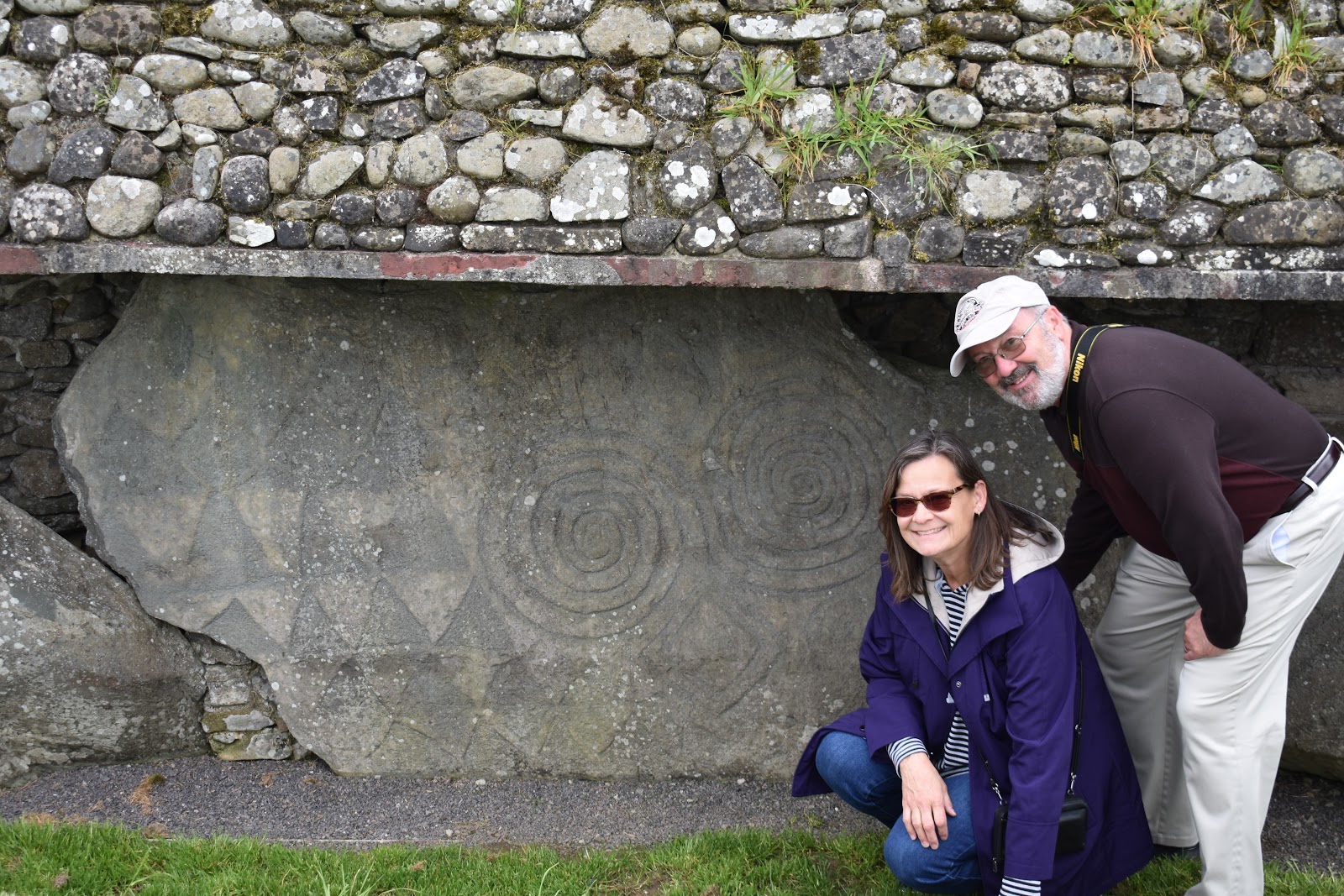


This stone is at the entrance of Newgrange, and the triple swirl to the left is repeated inside, in one of the chambers.  It has become the symbol of the sites. 


And, sheep.  There are sheep everywhere in Ireland, as you will see if you keep reading these pages!


We then headed further north, into Down county.  We wanted to visit Down Cathedral, in the city of Downpatrick.   Downpatrick has been an important site since ancient times, and St Patrick is said to have visited here.  He is also believed to be buried in the cemetery there; at least a stone has been there for many, many years. 


 St Patrick's Cross, reinstalled in 2018

An older cross on the grounds.

And a view to the south of the cathedral.


Saturday, May 25, 2019

Glendalough

Wednesday we decided to spend a day in the woods.  We went to Glendalough.

Glendalough is south of Dublin, and its name means "glen of the two lakes."  It is one of the most important monastic sites in Ireland.  It was founded somewhere around 600 by St Kevin, an ascetic who gave up the noble life he was born to for one of prayer and contemplation.  Unfortunately for Kevin, he was so good at what he did that people wanted to come and learn from him, which left him little time for prayer and contemplation.  He established a monastery at Glendalough, and then ran away briefly.

The site has a round tower, several churches, some stone crosses, a site called Kevin's Cell, and another called Kevin's Bed.  Several stories are told about Kevin.  The one I liked best involved a hollowed out stone and a deer.  Seems some ladies showed up at Glendalough, seeking shelter, but had nothing to feed their babies.  A passing deer stood up on the stone and allowed herself to be milked, so that the milk could be fed to the babies. Apparently, the animals also trusted Kevin.

We were sore from hiking Dublin the day before, but it was still a lovely day in a lovely place.  Wanna see some pictures?


This is inside the cathedral.  It was dedicated to SS Peter and Paul, probably started in the 10th century, but ceased being a cathedral by 1214.


A stone cross in the cemetery surrounding the cathedral.  The cemetery is still in use,


St Kevin's church, also called St Kevin's Kitchen, because the tower looked like a chimney, to some.
Probably from the 12th century.


The Round Tower at Glendalough, built between 900 and 1200, was used for a bell, to call monks to prayer.  Its floor is high above the ground, and the tower had several floors.  The thinking is that, if someone were to attack, the monks could climb inside, and pull up the ladder, closing themselves in for safety.

The Reefert Church.  Built around 1100, its name comes from the Irish, and refers to its use; it was where the local kings, from the O'Toole family, were buried.


Guess what this is?


St Kevin's Cell.

The Upper Lake of Glendalough.  Seems I missed out on taking a picture of the Lower Lake, but this one is prettier, anyway.


Heading back to Dublin, we found the Old Military Road, built by the British for use when they were searching for Irish rebels after the Rebellion of 1798.  We went up through Glenmacness and over the Sally Gap.  It was beautiful, reminding us of Skyfall, or the Trail Ridge Road in Rocky Mountain National Park.


These yellow-flowering shrubs were everywhere, used as hedges for animals.  They're called gorse, and they can be as much an aggravation as they are pretty.  And they smell, surprisingly, like coconut!  (I found out today that the flower is poisonous, but, when the seed forms, it is edible, and is like a pea.)


Friday, May 24, 2019

A Little Out of Order

Today's breakfast view.


Today's afternoon coffee view.


These were taken from the windows of our B&B, Shoreline at Mount Stewart.  This is a truly lovely place, probably one of the best B&Bs we've ever stayed in.  We really enjoyed our time there; lovely room, great food, and an amazing view of the Lough, right out our bedroom and breakfast room windows.  We want to come back in a couple of years, and just spend a week, relaxing.

Dublin, Part 2

Interesting discovery about our day in Dublin.  John actually took very few pictures, although we waited, often, for him to do so.  Lots of architectural detail, though!

After the Brazen Head, we took a walk along some streets north of the river, seeing barristers and solicitors and shoppers and finally landing at The Church, which was just that.


 A church, now a restaurant. 

We had a nice lunch before heading up the street to the General Post Office.  One of our main purposes for this trip was to understand a little bit of why John's family emigrated.  His great-grandfather left in 1920; his wife and children left in 1922.  This was right at the time of the War for Independence and the Civil War.  The War for Independence had a start in the Easter Rising of 1916, which started when Irish rebels took over the General Post Office on Easter Monday of 1916.  (Cormac told us they would have done batter to take Dublin Castle, but, there you are.)  They were there for about a week, before British shelling got the better of them, and they surrendered.

We walked along lanes, seeing where a neighbor of ours charged a British barricade.  Seriously, the O'Rahilly lived in a house around the corner and up the road a block or so from where we are staying.  He bled to death in a doorway, but not before writing a sweet note to his wife, which reads

Written after I was shot
Darling Nancy,
I was shot leading a rush up Moore St took repose in a doorway.
While I was there I heard the men pointing out where I was and I made a bolt for the lane I am in now.
I got more one bullet I think.
Tons and tons of love to you + to the boys + to Nell + Anna.
It was a good fight, anyhow.

Please deliver this to Nannie O'Rahilly 40 Herbert Park, Dublin
Good bye darling


"It was a good fight, anyhow." 


We saw where nurse Elizabeth O'Farrell bravely walked up to the British to negotiate the non-negotiable surrender, and where Patrick Pearse actually did surrender.  Then we took a tram ride out to the west of the city, to Kilmainham Gaol,


and heard of the executions of 16 of the rebels.

We ended the day in front of a little cafe around the corner from the O'Rahilly's house.  Cormac left us to enjoy a lovely dinner, we then walked home, and we fell into bed!

Tuesday, May 21, 2019

Dublin: Part 1

Today was Dublin.  We had a most excellent guide, Cormac Gordon, who walked us through as much of Dublin as our feet could handle, and then some.  We talked about history, culture, government, rivers, mountains, and wide open spaces.  Some of you might find it surprising that we set foot in NO churches, although we saw at least 4.

Dublin gets its name from the Irish for "dark pool."  The river Puddle, which runs through Dublin,  is a river dark with sediment.  In ancient times, it made a turn, forming a pool that was, well, dark.  We saw the park where this pool once was. 
No, it didn't dry up.  The city was built up over it, and the Puddle now runs underneath the city.  It comes out into the river Liffey at a really insignificant place., which we somehow didn't get a picture of.  Think of a plain Jane sewer grate.

We started with Trinity College, and the Book of Kells.


I have wanted to see this since, probably, high school, and almost didn't.  I had heard many say they were really disappointed by it.  But Cormac talked me into it, not that it took much arm-twisting, and got us there early enough to beat the crowds.  THAT seems to be the secret.  It was beautiful, as was the Long Room, which we also saw. 
The smell of old books.....
Among the interesting things we saw in the Long Room were an original copy of the Proclamation of the Irish Republic (think Declaration of Independence, my American friends)
and the Brian Boru harp, symbol of Ireland...and, yes, Guinness.
We left Trinity College, and saw the pre-Union Irish Parliament building, which is now a bank.  The House of Lords is still there.  The House of Commons was removed as a condition of the bank's purchase.

After a coffee stop, we walked through the walled part of the city, which was founded by the Vikings.  The pictures I took included the "footprint" of a Viking house.

We saw Dublin Castle, St Patrick's 
and Christchurch Cathedrals,  the place where Handel first performed Messiah, and the oldest pub in Dublin.  (I had ginger ale, John had a half pint)  


It was a gorgeous day, and there's more to tell.  But I'll let you chew on that for a bit.